
A rocky start to a key process
The week of 16 July saw the unveiling of the Commission’s proposal for the Multiannual Financial Framework (MFF) 2028–2034. The process was anything but smooth, with a four-hour delay in the initial presentation to Parliament by Piotr Serafin, the Polish Commissioner responsible for the budget. It appears there were last-minute changes, suggesting intense internal battles.
A process is now underway which should be concluded before 2028, likely under the Greek presidency, and will result in the adoption of a package of new regulations for the forthcoming period. With its homework done, Brussels heads off on holiday, leaving us with plenty of summer reading [1].
What changes does the July 16 proposal bring, and how significant are they? Does it predict the final framework, or will it change significantly? These are the questions that led me to write this post.
I will proceed as follows:
1 – Present the general context of the MFF negotiation and the actors involved
2 – Examine the changes proposed in the MFF regarding the CAP and Cohesion
3 – Assess the expected evolution concerning the allocated amounts
4 – Propose a hypothesis regarding the management mechanism
1.- The need to balance many conflicting interests
The MFF, once an agreement between EU institutions and now a regulation, is crucial for setting the EU’s seven-year budget. The EU has a very small budget in terms of GDP (just over 1%) but with a volume exceeding one trillion euros per period. This alone justifies attention to its reform, but additionally, MFF changes have historically involved “reforms in terms of authority and the distribution of powers among levels of government”[2]
We are thus facing a complex negotiation. It is a zero-sum game: if the overall budget does not increase, every euro gained in one area will be a euro lost in another. For more resources, contributor countries must provide more, taking it from their national budgets. The only alternative would be to increase own resources or resort to debt. This change would be almost revolutionary in the long term, but appears to be blocked[3].
The approval of the new MFF requires unanimity in the Council, meaning any state can block the agreement. It also needs the consent of the Parliament. However, negotiating positions are not straightforward because the interests at stake are numerous, and whatever the balance, there will always be winners and losers within each state. As in the past, approving the MFF will resemble a combined exercise in political acrobatics and juggling.
In such a negotiation, the one who makes the first proposal holds significant power: they set the terms of the debate and the benchmark against which everyone will evaluate the outcome of the negotiation, whether they have won or lost. This is the power of proposal already exercised by the Commission.
From now on, although media rhetoric may personalise it as Brussels, the negotiations will primarily be among governments, as agreement is needed within the Council. The Parliament must give its approval and may threaten to block, but its power lies in demanding something “acceptable” to the majority of the chamber, not in modifying specific aspects. Once the proposal is made, the Commission is supposed to play a merely technical role but it has interests in the outcome, some influence over timing, control of information, and a specialised group of officials, not an insignificant power[4].
Reactions to the proposal from some states were swift. The Netherlands was among the first to express strong opposition: “too large, dead on arrival” [5] Statements in the opposite direction (“too little, more is needed”) have been less clear, but it is evident that the proposal does not meet the expectations of countries like Spain and France, which hoped for a larger amount based on EU own resources[6]. As Serafín Pazos-Vidal has written, the Commission has set the “stage before the battle”[7]
Non-state actors are also sharpening their weapons. Each will use their tools to play their cards and influence the process. Among them, two groups have been the main beneficiaries of the EU budget and will be most involved: the regions (beneficiaries of the Cohesion Policy) and the agricultural sector (beneficiaries of the CAP[8]), the two components of this MFF on which we focus our attention.
2.- The changes in the new proposal
The Commission defines its proposal as “an ambitious budget for a stronger Europe,” but is this true for Cohesion and CAP? When comparing it to the past, it’s not so easy to assess due to two significant changes.
Change 1: A “megafund” grouping different funds
The 2021–2027 MFF has an amount of €1,210,894 million divided into seven headings[9]. The proposal for the 2028–2034 period amounts to €1,984,894 million divided into four headings, including the repayment of NGEU funds. This change in structure makes comparisons between periods non-trivial. For CAP and Cohesion, it is even more challenging.

In previous periods, over 90% of the budget was pre-allocated, distributed among funds with specific purposes and recipients. In this period, within Heading 1, there is an amount of €865,076 million (47.63% of the total, excluding NGEU repayment) whose destination is not pre-established. It will include (among others) the funds for CAP and the Cohesion Policy.
The fund has an accordion-like name: “Fund for Economic, Social and Territorial Cohesion, Agriculture and Rural Development, Fisheries and Maritime Affairs, Prosperity, and Security.” This name is complex because its composition is equally so:
- It has a general part that “replaces” the ERDF, Cohesion Fund, ESF+, EAGF, EAFRD, EMFAF, and the Just Transition Fund[10].
- It also has two special parts: for Security Policy and the Social Climate Fund.
To analyse the joint evolution of CAP and Cohesion between periods, the most appropriate comparison would be between the total of the general part (€748,900 million) and the sum of the funds it replaces (€744,900 million). This would represent a 0.5% increase in current prices[11][12].
Calculating the specific evolution of Cohesion or CAP is simply not possible because these amounts are not yet fixed. For now, there are no specific allocations, only minimum amounts for some components (“ring-fenced”). The final allocation will only become clear at some point in 2028 and will largely be a decision of each Member State[13]. Nevertheless, agricultural organisations have already raised their axes, and the idea of a 20% reduction has spread. Although this figure lacks foundation, I am confident we will see tractors on Rue de la Loi[14].
Until the allocation is made, rather than looking at the MFF as a whole, it makes more sense to examine each Member State individually. The new territorial allocation rules[15] mean that, despite a global increase of 0.5%, there are significant differences between states, ranging from an 8.3% reduction for the Czech Republic to a 13.9% increase for Luxembourg.
Change 2: A National and Regional Partnership Plan (PNRP) to Distribute Them
As a consequence of the “merger/disappearance” of the funds, the programming instruments used are also replaced.
In the current MFF, the Cohesion Policy has a general framework for each state: the Partnership Agreement[16]. Within it, each fund can be distributed across one or several programmes, which may cover the entire state or parts of it (Regional Programmes). For the CAP, the mechanism is different; since the last reform, for the 2023–2027 period the programming instrument is a single Strategic Plan for the CAP. We have now more than 500 Cohesion programmes and CAP Strategic Plans exceeding 3,000 pages.
According to the proposed regulation, this multitude of instruments would be replaced by a single plan per country, as set out in Title III (Articles 21–25) and Annex II.»
This is the aspect that has raised the most rejection from the regions, with vocal statements from the Committee of the Regions. Its president, Kata Tüttő, has written on her X account: “behind the simplification smoke, a MONSTER plan emerges to swallow cohesion policy and crack its backbone by nationalising and centralising[17].”
Just as the agricultural sector is reacting to reductions that may turn out to be windmills, there are no clear indications of renationalisation in the proposed regulations—quite the contrary, there is an explicit intent to dispel that shadow[18].
The participation of regions in the Cohesion Policy at the EU level has been based on the possibility of programming funds at a regional level and on the possibility of delegating certain management authority functions to regional authorities (as Intermediate Bodies). I emphasise “possibility” because it has never been an obligation. As shown in the following table, the wording on these aspects in the regulatory texts remains essentially identical.
| Current regulation (CDR) | Proposal |
| Art. 22.1. Member States shall prepare, in cooperation with the partners referred to in Article 8(1), programmes to implement the Funds for the period from 1 January 2021 to 31 December 2027. | Art. 21.2 Each Member State shall prepare and implement the Plan in partnership with partners as set out in Article 6 [Partnership], including regional and local authorities, and in accordance with their institutional, legal and financial framework. The Plan shall include national, sectoral and, where relevant, regional and territorial chapters. |
| (art. 71.3) The managing authority may identify one or more intermediate bodies to carry out certain tasks under its responsibility. Arrangements between the managing authority and intermediate bodies shall be recorded in writing. | The managing authority may identify one or more intermediate bodies to carry out certain tasks under their responsibility. Arrangements between the managing authorities and intermediate bodies shall be recorded in writing. The tasks delegated to intermediate bodies shall not be entrusted further to other bodies. |
The fact that Member States could use the PNRP to centralise fund management, as some claim it has happened with the PRTR, is a separate matter. This would be independent of European regulation and would respond to other dynamics.
Looking at the proposal itself, Member States could still preserve internal balances by turning their existing Regional Programmes into regional chapters within a single national PNRP. This approach has already been applied to the CAP in Belgium.
3.- How will the amounts turn out?
The negotiations starting now will change all the figures in the initial proposal. Can we know how much and in what directions? To get an idea, it may be useful to study what happened in previous periods.
The following tables reflect, for the last three financial frameworks, the comparison in current euros between the Commission’s starting point and what was finally approved[19].

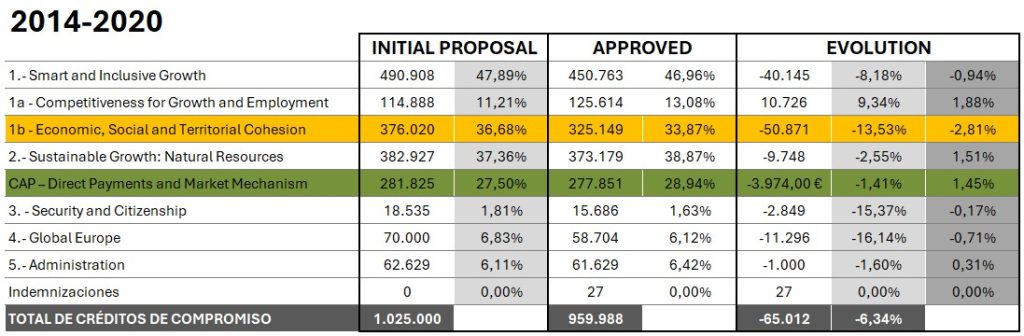

From the data, it seems we are at the start of a well-rehearsed play, with actors reciting a familiar script. In the first act, the size of the budget is discussed, with frugal countries seeking to reduce it, while net beneficiaries aim to increase it. In the second part, the destination of the funds is debated, with northern countries betting on innovation and competitiveness, and southern and eastern countries wanting more resources for CAP and Cohesion. Although the names of the headings and the faces of the actors change between performances, the third act’s outcome is always the same: a compromise. The overall amount ends up lower than the initial proposal, and CAP and Cohesion increase their relative weight. There are no dramatic increases, but sufficient changes to allow everyone to save face in the negotiations.
The reduction of the overall budget has been consistent: 15% in 2007–2013, 6.34% in 2014–2020, and 5.31% in 2021–2027. The increase in relative terns of these items (from 1.5% to 4.5% in the extreme case) has also been consistent, with the sole exception of Cohesion Policy in 2014–2020, something attributable to the period’s exceptional nature[20].
Will the pattern repeat? Denmark, one of the frugal countries, has incentives to increase EU spending, provided it is on defence, as do the Baltics. Spain, shifting from a net recipient to a net contributor, will not view the Cohesion Policy with the same eyes. Hungary, in its illiberal drift, might leverage its veto power for other interests. While there are new dynamics, I believe the underlying forces persist, and my impression is that the script will continue to apply, with the same outcome.
4.- What will happen with the PNRP?
As we have seen, opposition to the Commission’s proposal is not only about the reduction in amounts but also about their grouping. “The CAP is not identified individually, and its importance to Europe via budgets is not made clear,” the Spanish Minister of Agriculture, Fisheries and Food recently stated[21]. Beyond the fight to increase their share of the pie, traditional beneficiaries of Cohesion and CAP want their own envelope and to abandon the PNRP-based management model.
While I believe there is some uncertainty regarding the amounts, I think the response to this demand is clearer. This request is likely to have little traction, and the Commission’s proposal will essentially be maintained. I base this on four reasons, the first three being well-founded and the fourth more of an intuition.
Reason 1 – PNRPs build on an already trodden path
In the CAP domain, Strategic Plans have already been implemented, and in the Next Generation domain, Recovery Transformation and Resilience Plans have been used, both serve as models for these plans.
Regardless of any criticisms of their functioning, moving forward on this path is no longer venturing into unknown territory. There are (or will be) IT tools adapted to this mode of operation, and staff in ministries and regional governments will already be familiar with it. PNRPs are not a radical innovation but a predictable evolution.
Reason 2 – It’s a technical matter within the Commission’s area of influence
Historically, Member States have fought over the “what” and the “how much” (priorities and allocations), but not the “how”. There may have been specific methodological adjustments, but not a challenge to the whole system to propose an alternative. This is likely to happen again.
The technical structure of each institution is different. The Commission has an army of officials who understand the EU’s mechanisms and have crafted the proposal for the coming period. Member States have officials serving their respective governments. Neither the Council nor, much less, the Parliament has the technical infrastructure to develop a comprehensive counterproposal to restructure fund management.
This applies to the PNRP as a whole, and likely to Annex I, which determines allocations by state.
Reason 3 – Member States have no incentives to oppose this process
If, as opponents argue, PNRPs imply a renationalisation of policies, the Member States in the Council, who must approve this process, would be the main beneficiaries and thus the first to support the reform.
Beyond any “nationalising” impulse, transferring certain decisions to the national framework provides greater flexibility for each state to adapt to its institutional specificities.
With this in mind, the unity between regions and the agricultural sector to oppose this reform may disappear. It seems the agricultural sector has greater bargaining power with their governments than with the Commission, making them beneficiaries of this shift as well.
Reason 4 – Grouping is instrumental to making further reductions in CAP and Cohesion feasible
The CAP emerged at the EU’s founding moment as part of the Franco-German compromise, in a context where Europe was highly dependent on external food production. Its intervention mechanism, subsidies, seems to belong to a bygone era.
The Cohesion Policy was initially introduced in the 1980s to support the integration of countries with significantly lower development levels than existing Member States. This need re-emerged during the 2004 and 2007 enlargements. The policy was conceived as a temporary measure, intended to phase out once economic convergence had been achieved.»
Although there have been profound transformations in both policies, my intuition is that they still respond to an earlier stage of the EU’s evolution, and their destiny is to diminish in importance. The following table shows the weight of these items in the total budget, both jointly and separately[22].

The percentage allocated in the Commission’s proposal (47.63%) continues this trend. Grouping is a tool to make reductions possible. In this way, future reductions will be perceived more diffusely, minimising direct conflicts with traditional CAP and Cohesion beneficiaries or redirecting this conflict towards Member States.
5. Conclussion
We are in the early stages of formulating the EU’s next Multiannual Financial Framework, an instrument of immense importance as it determines medium-term political priorities and the distribution of power among administrative levels.
The European Commission’s proposal for Cohesion and CAP points to maintaining the budget in nominal terms (i.e. a reduction in real terms) and grouping them into a common fund with management mechanisms similar to those tested with the PRTR. Despite public proclamations, these elements represent a continuation of the current approach
If history is a guide, we can predict with some confidence what will happen: the proposed management changes will be adopted, and the reduction of amounts in real terms will also occur. Nevertheless, it is likely that Cohesion and CAP will increase their relative weight in the final approved budget. This would repeat well-established patterns.
However, caution is needed in any prospective exercise. The current scenario does not replicate previous ones, and Member States’ positions are evolving. The polycrisis situation and geopolitical factors may have hard-to-predict consequences.
[1] All proposals can be found here:
https://commission.europa.eu/strategy-and-policy/eu-budget/long-term-eu-budget/eu-budget-2028-2034_en#legal-documents
[2] The quote is from a paper by Mario Kölling, which reviews how negotiations unfolded in previous periods and serves as a basis for some of the reflections included here.
https://doi.org/10.24965/gapp.11467
[3] The possibility of mutualised debt has not been entirely ruled out. A new instrument—Catalyst Europe—is envisaged. It would offer loans backed by the EU budget, up to a ceiling of €150 billion, targeting investments in strategic sectors such as key technologies, energy infrastructure, and defence industrial capacity.
[4] An accessible and informative text on the twists and turns of EU negotiations can be found here:
https://www.eipa.eu/blog/dealing-with-the-twists-and-turns-of-european-negotiation-process-part-3-1/
[5] https://www.reuters.com/markets/europe/germany-netherlands-sweden-oppose-eu-common-borrowing-2025-07-18/
[6] https://www.euractiv.com/section/politics/news/spain-urges-eu-to-double-budget-brace-for-trump/
[7] https://agendapublica.es/noticia/20028/presupuesto-ue-2028-2034
[8] While not explicitly mentioned references to Cohesion and CAP also include fisheries. Also included, although more obviously, is rural development, the second pillar of the CAP.
[9] Breakdown of the current MFF in current prices:
https://commission.europa.eu/document/download/31a0d09a-2548-49b8-8d85-d6342ad76d29_en
[10] ERDF, ESF, and the Cohesion Fund will continue to exist, as they are enshrined in the TFEU. The Commission’s proposal includes regulatory provisions for each of them.
[11] Figures cited are taken from posts by Professor Alan Matthews, in particular:
http://capreform.eu/which-countries-gain-or-lose-from-the-national-and-regional-partnership-fund/
[12] These represent a significant cut in real terms (taking inflation into account), though the 20% figure often mentioned seems to refer to nominal terms.
[13] The proposed regulation does not provide detailed allocations but rather reserves (Article 10). These reserves exist for the CAP, fisheries, and less developed regions. These figures are not the amounts earmarked by the MFF for each priority, but rather the ring-fenced minimums—the lower bound for overall fund distribution.
For this reason, we cannot yet say whether the funding for fisheries, agriculture, urban development, or any previously earmarked item has increased or decreased. These allocations will only become clear once the National and Regional Partnership Plans are approved. Under this mechanism, it is perfectly possible that funding for urban development will increase in the Netherlands but decrease in France compared to the previous period.
[14] More reactions from the agricultural sector:
https://toledodiario.es/upa-y-asaja-castilla-la-mancha-creen-que-el-recorte-en-la-pac-lleva-al-sector-a-un-callejon-sin-salida-nos-toca-estar-en-la-calle/
[15] Annex I of the Regulation includes the allocation by country.
[16] The Fisheries Fund is also part of the Association Agreement.
[17] https://www.eunews.it/en/2025/07/16/european-parliament-slams-commissions-eu-budget-proposal-its-a-joke/
[18] One of the supporting documents to the Commission’s proposal reflects the intention to preserve the role of regional governments:
“Each Member State, with close involvement of regional and local authorities and other relevant stakeholders, would be responsible to draw up their plan and to propose the relevant key investments, other instruments, and reforms, which could be organised in thematic/sectoral and/or regional chapters.” (SWD_2025_565_1)
[19] Sources for the historical budget tables:
2007–2014
- Initial document: COM(2004) 498 final – Proposal for renewal of the Interinstitutional Agreement (14/07/2004)
- Final document: Interinstitutional Agreement on budgetary discipline and sound financial management (2006/C 139/01 – 14/06/2006)
- Presidencies: Austria / Finland
2014–2020
- Initial document: COM(2011) 500 final – A Budget for Europe 2020 (29/06/2011)
- Final document: Council Regulation (EU, Euratom) No 1311/2013 (2/12/2013, OJ L 347, 20/12/2013)
- Presidencies: Ireland / Lithuania
2021–2027
- Initial document: COM(2018) 321 final – A Modern Budget for a Union that Protects, Empowers and Defends (02/05/2018)
- Final document: Council Regulation (EU, Euratom) 2020/2093 (17/12/2020, OJ 20/12/2020)
- Presidencies: Croatia / Germany
[20] In the 2014–2020 period, Cohesion Policy suffered a particularly sharp cut—€50 billion—out of a total €65 billion reduction. This was the only instance where regional policy lost ground relative to the original proposal. It occurred under exceptional circumstances, in the context of post-2008 austerity and after the bulk of enlargement costs had already been absorbed.
[21] He also continues here with the narrative of a 20% cut without clarification as to what exactly is being referred to
https://www.lavanguardia.com/economia/20250727/10927352/planas-ce-le-faltado-ambicion-sobre-tamano-presupuesto-global-ep-agenciaslv20250727.html
[22] Final tables prepared using data from this study:
https://www.europarl.europa.eu/RegData/etudes/STUD/2024/636475/IPOL_STU(2024)636475_ES.pdf‹
